Google Just Made Search Console Smarter
AI-powered configuration in the Performance report – useful feature or just a shiny button?
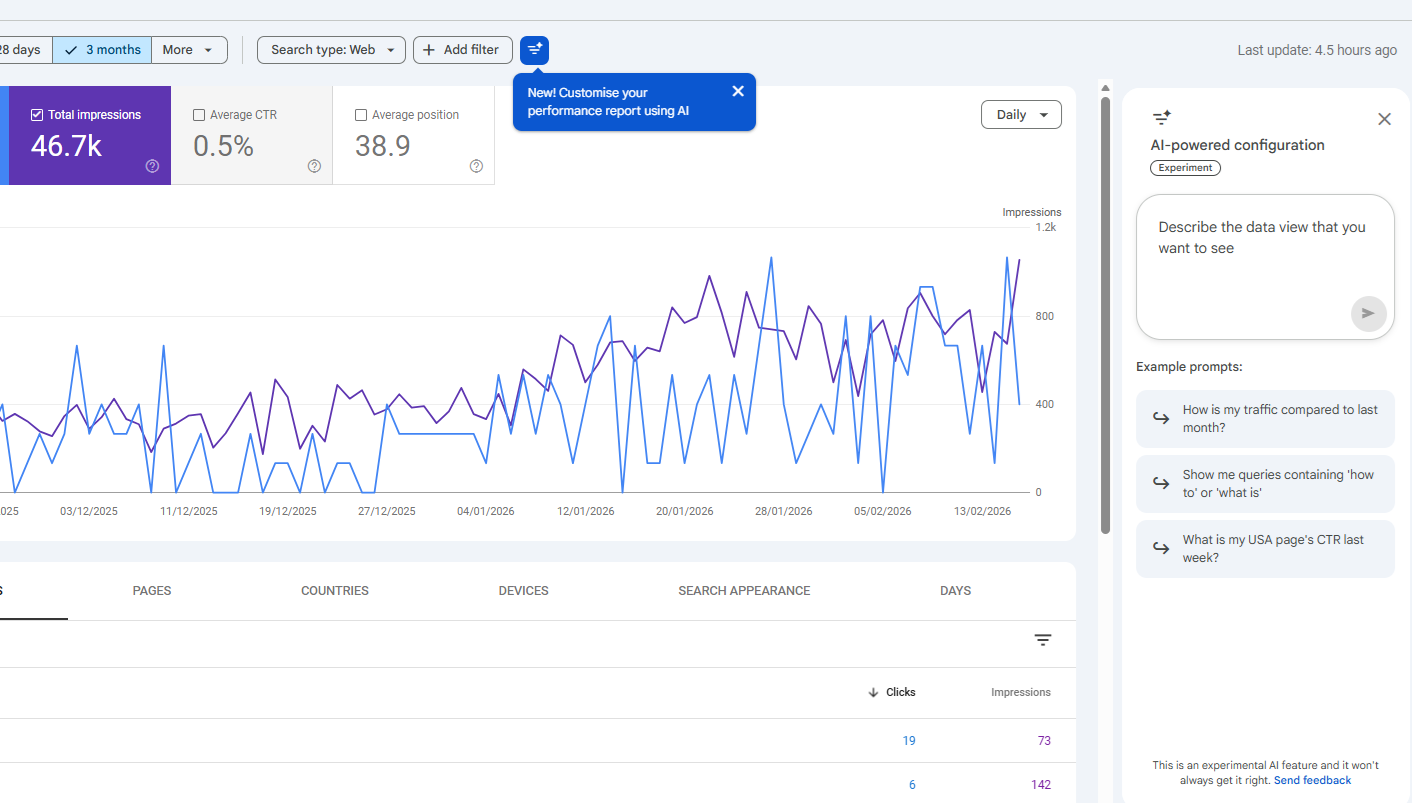
Google quietly rolled out an experimental feature to Search Console in December 2025: AI-powered configuration for the Performance report. The pitch is simple – instead of manually stacking filters, you describe what you want to see in plain English and the AI sets it up for you.
Worth understanding properly before dismissing it as a gimmick.
What it actually does
The feature handles three things in the Performance report:
Filter application – query, page, country, device, search appearance, date range. You type what you're after, it applies the relevant filters.
Comparison setup – custom date range comparisons without manual configuration. This is where it saves the most time. Setting up pre/post period comparisons is tedious. If AI can do that reliably, it's genuinely useful.
Metric selection – surfaces the right metrics for your stated analysis goal.
What it doesn't do: sorting, data export, Discover reports, News reports. It's scoped to Search results in the Performance report only.
The honest limitations
Google's flagged these themselves, which is worth noting:
Accuracy isn't guaranteed. AI can misinterpret requests. You need to review the suggested filters before you trust the output. This isn't a "set and forget" feature – it's a configuration assistant, not an analyst.
Limited rollout. Available to a limited set of websites initially, expanding gradually. So you may not have access yet.
The scope is narrow. One report, one search type. It's a proof of concept, not a platform overhaul.
Why it matters despite the limitations
The Performance report is powerful but genuinely friction-heavy for non-technical users. The number of clients and in-house teams who never dig beyond top-level impressions and clicks is significant – not because they don't care, but because the configuration overhead puts them off.
If natural language filtering lowers that barrier, more people actually use the data. That's a net positive.
For experienced SEOs, the real value is speed. Setting up a custom date comparison for a specific page cluster filtered by device type takes seconds if you can just describe it. Whether the AI interprets complex requests accurately is an open question.
What to watch for
The feature feeds on your descriptions. Vague inputs will produce vague configurations. Be specific: "Show me mobile traffic for /category/womens-dresses/ comparing the four weeks before and after the August core update" will produce something more useful than "show me how my dresses page is doing."
Always verify that the filters it applies match your intent before drawing any conclusions. An incorrectly configured comparison is worse than no comparison; it creates a false reading that influences decisions.
Useful if it works as described. Experimental in the genuine sense, and accuracy isn't guaranteed, and the scope is limited. The concept is sound: reduce configuration friction so more people engage with performance data. Whether the execution delivers that in practice will become clear as it rolls out more broadly.
Check if you have access and test it with a specific analysis you'd normally set up manually. That's the fastest way to judge whether it earns a place in your workflow.